New Group Provides a Safe Space for Women to Build Their Confidence in Speaking

Naotkamegwanning Arena housed some much needed giggles and encouraging applause.
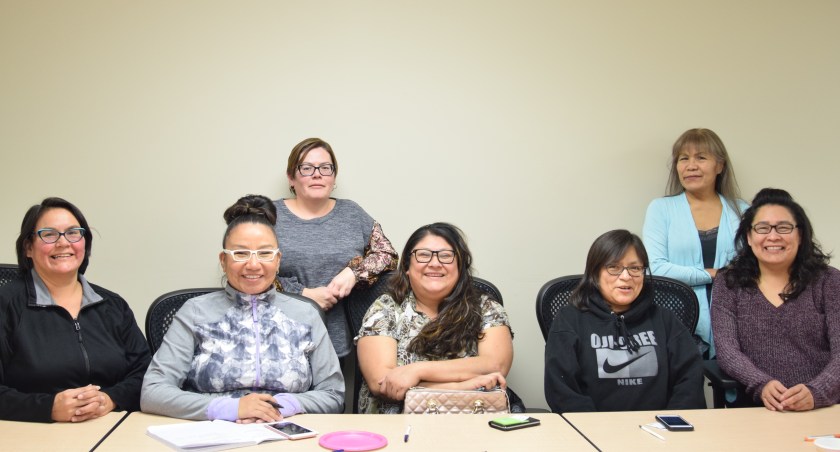
Toastmasters-Karli Zschogner
Front: Darlene Oshie, Rolanda Wilson, Marilyn Leask, Rose Mary Paypompee, Darlene Paypompee Back: Laura Kakeeway, Patricia Biggeorge (Photo credit: Karli Zschogner)

By: Patricia Biggeorge

Ikwewag Toastmasters Club began in the community of Naotkamegwanning in October 2018 at the request of a couple of ladies in the community. Darlene Paypompee was approached because she has been a toastmaster member for a few years.

“I saw a need in the community, and every other community, to learn how to speak in public, conduct meetings, to gain confidence to speak up, to work or join in various committees, and I wanted to support them,” she said, “So, I decided to organize Ikwewag Toastmasters Club where women (Ikwewag) could learn these skills in a social and safe environment.”

Toastmasters is an international network in communication and leadership development.  Some people may wonder why it is called ‘Toastmasters’. Founders of the YMCA realized that a space for encouraging better communication was needed. The name resembled a banquet with toasts and after-dinner speakers.

A Facebook page titled ‘Ikwewag Toastmasters Club’ was launched in early October. Local Indigenous women, 18 years and above, are invited –  not just in Naotkamegwanning, but anyone from neighboring communities.

The first two practices happened in the last two weeks with a minute to speak on a table topic chosen randomly. The ladies chose the topic based on a theme for the meeting. The seven women discussed with each other on how even speaking improv for one minute was exhilarating and they already felt safer and confident.

Darlene said there will be a poll on the Facebook page so that members will have an idea on what to say. The long term goal is to build enough skill and confidence to be able to speak without filler words such as umms and ahhs for 5 minutes. The clubs’ support builds research skills and the ability to speak on a certain topic with confidence.

Joining the club inspires the development of ten goals within a person on public speaking. These are evaluating one’s own speaking ability, preparing and giving speeches, giving impromptu talks, controlling voice, vocabulary and gestures, giving constructive feedback, building confidence, sharpening leadership abilities, improving improvisation, expanding networks, and sharpening speaking, listening, understanding and thinking skills.

It is up to the individual as to when these goals are achieved. The individual can compete in speaking competitions at the regional, national or international level. Membership in the Toastmasters Club provides this small Indigenous community an opening to the rest of the world.

If interested, women can join the Ikwewag Toastmasters Club Facebook page, and are encouraged to sit in on the bi-weekly meetings  starting at 6:00 pm. While the club is for 18 years of age and over, there is the opportunity to start a club for those under 18 years of age, or come to the next meetings.

Membership allows access to regular tips, magazines and competition. Registrations are being accepted, but until a membership of 20 is reached, the club cannot register to confirm its unique bilingual status with Anishinaabemowin.
An unexpected space of truth and reconciliation at Naotkamegwanning roundhouse

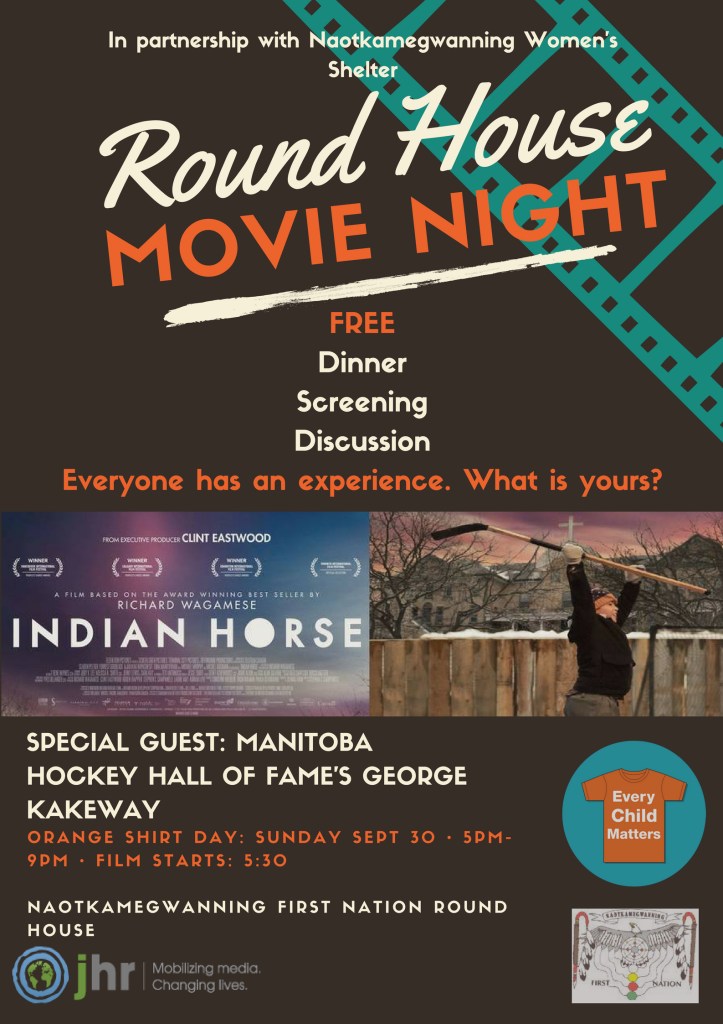
In recognition of Orange Shirt Day, Hockey Hall of Famer speaks at Indian Horse screening

By: Xavier Ranville and Wynter Taylor

It was a chilly last evening of September when Naotkamegwanning’s roundhouse was filled with more bodies than it has had in a long time – dedicated to residential school survivors.

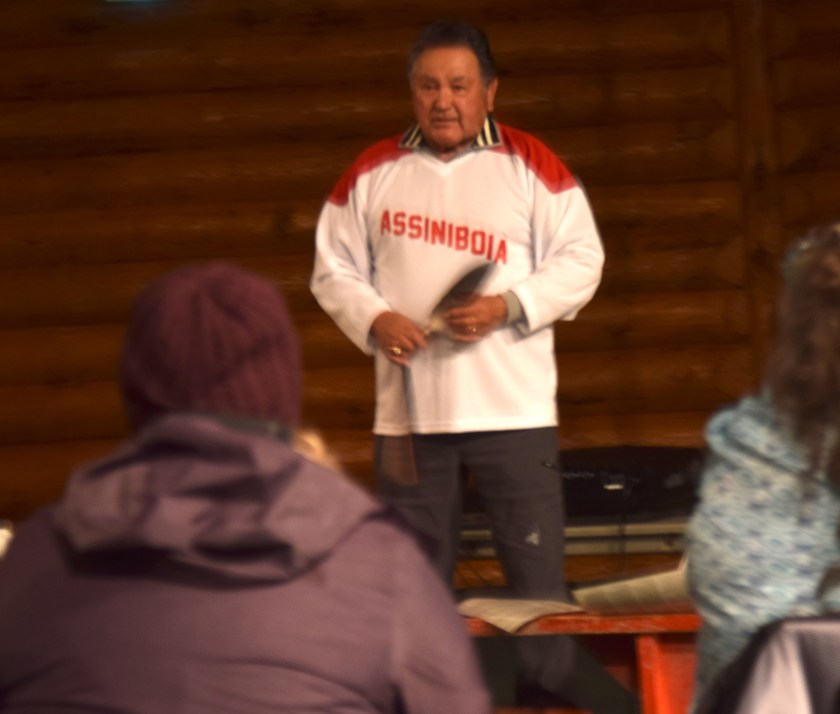
The 40 plus community members and guests of all ages enjoyed traditional foods as wild rice and bannock before sitting down for the big screen and local George Kakeway’s similar story of residential school survival through hockey.

“Be who you are because that’s how you survive,” said Kakeway in discussion after the award-winning film adaption of the novel by the late Northwestern Ontario’s Anishinaabe Richard Wagamese.

Indian Horse, follows the fictional Anishinaabe character Saul, and his experience at residential school and his talent through hockey. The story captures many of the realities of racism and ill treatment Indigenous persons have faced.

Sept30IndianHorseGeorgeKakewayRoundHouse_Xavier_recording-WynterTaylor
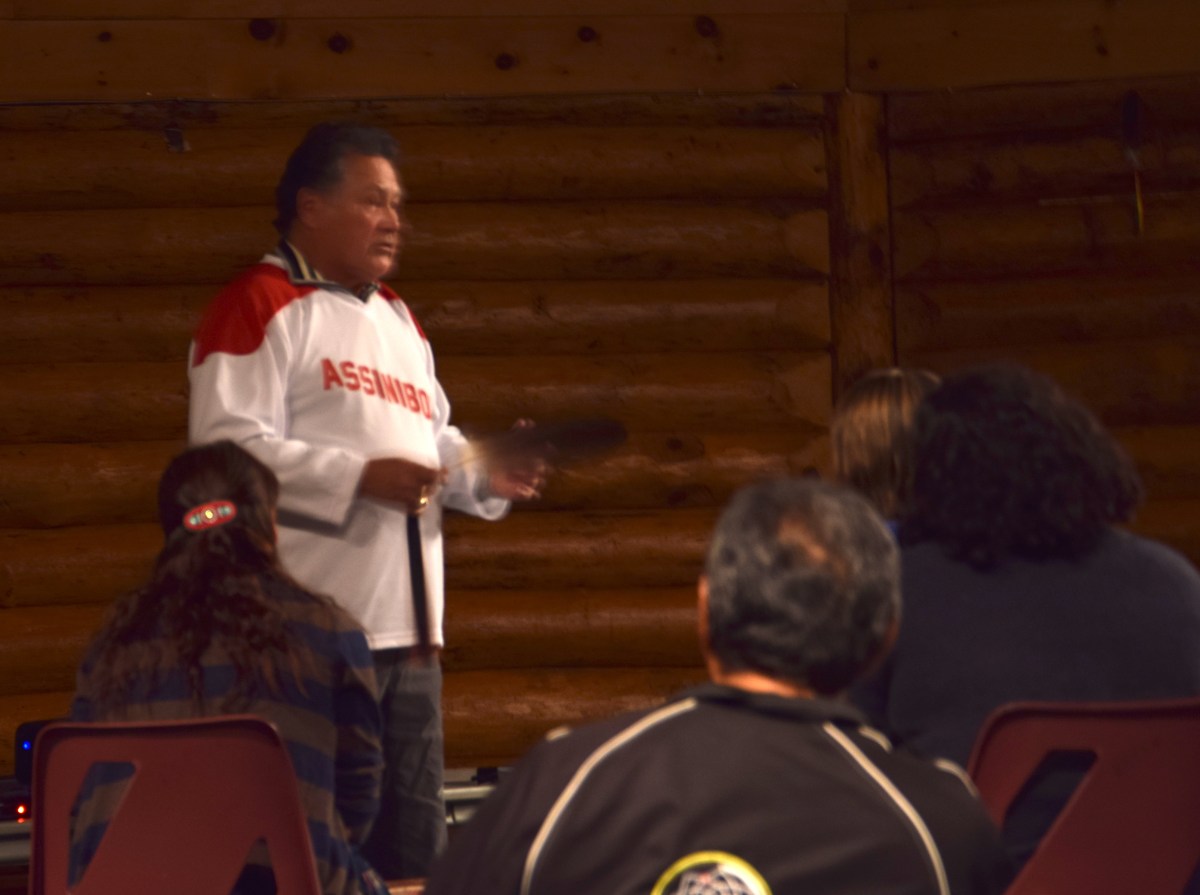
Kakeway as the only Indigenous boy played hockey in Kenora, later attending Assiniboia Residential School with later Assembly of First Nations National Chief Phil Fontaine (Photo Credit: Wynter Taylor)

The film left many people in tears touched by the story, either seeing for the first time on screen the real experiences of their loved ones or because they had no idea of this part of Canada’s history and what they went through.

Like many adults and elders like Wauzhushk Onigum First Nation’s George Kakeway, the story of Saul and his peers was very much a reality.

“As a survivor it becomes very hard to express what we went through,” he said in the community discussion.

George was taken from his home in 1951 at the age of 6.  He talked about his time at St. Mary’s Catholic Residential School in Kenora, that his hair was cut bald and punished for speaking Ojibwe. He expressed that this place, along with its sanitarium, was one of the loneliest places.

“The intent was to assimilate us, not to educate us,” he said.

Like character Saul, he was an orphan at age 10, and hockey had come available for him and he excelled, not just out of interest but a method of survival from experiences.

Wynter Taylor - George Kakeway
George Kakeway said he would use hockey and other sports to get it out of your mind and survival. (Photo Credit: Wynter Taylor)

He said hockey gave him the opportunity to chose to go to Winnipeg’s Assiniboia Residential school which let him study and also gave him time to play hockey. His focus led him to become the chief at his home at the young age of 25.

In October of last year George and his team were inducted into Manitoba’s Hockey Hall of Fame.

September 30, Orange Shirt Day is not just the last day of the month but a national movement, and proposed national holiday of sharing residential school experiences. It remains a hard day for many elders to relive and share, taking courage.

Kakeway Indian Horse Screening Poster
Indian Horse Screening Poster (Photo Credit: Karli Zschogner)

While having heard about residential schools, Judi Cannon, a non-indigenous attendee, was overwhelmed to learn about what was going on inside and outside of the residential schools.

“I can’t even believe it would happen,” she said.  “I don’t understand how people could treat other people that way.”

Cannon, Director of Ontario SPCA for Partnerships and Community Outreach, along with her crew were invited into the community for their second year extraction of unaccounted for dogs.

Event was put on by the community’s journalism trainer and the community’s Women’s Shelter.

Naotkamegwanning youth learn respect to wildlife

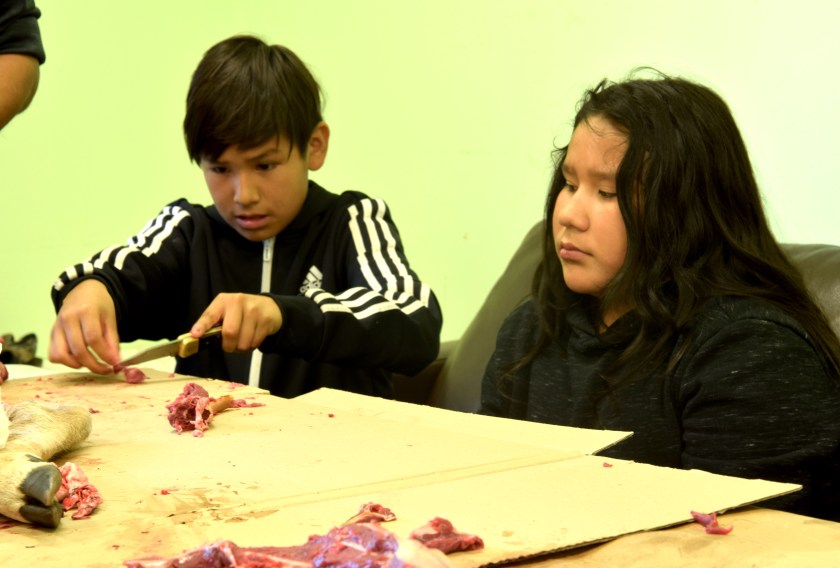
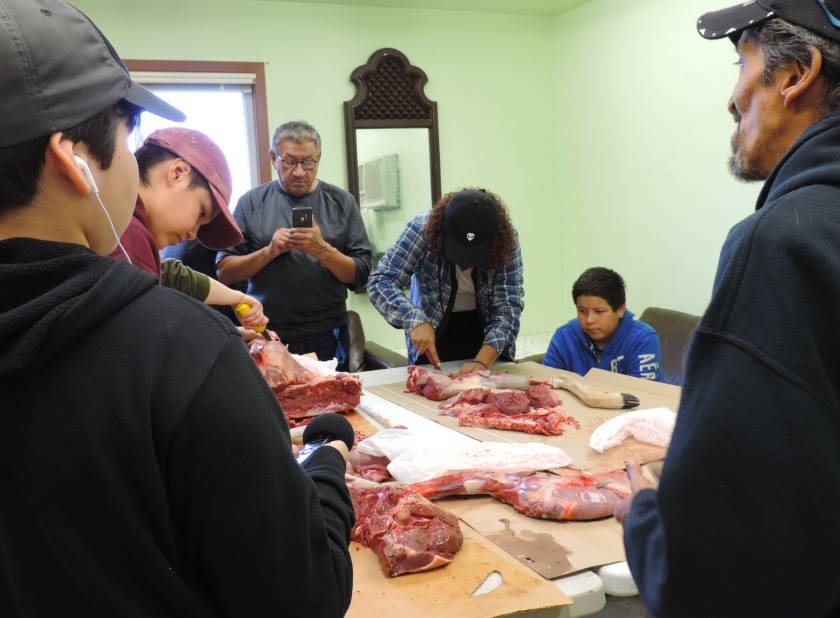
KelsiB. Carter Nash cutting up meat
Carter Nash cutting up meat (Photo Credit: Kelsi Blackhawk)

By: Ocean Sky Tom

Students at Baibombeh Anishinaabe School got their hands all bloody last Thursday October 4 .

For Grade 7 and 8 Ojibwe language and land –based classes they were invited to Shawendaasowin Prevention Services to learn how to harvest a deer.

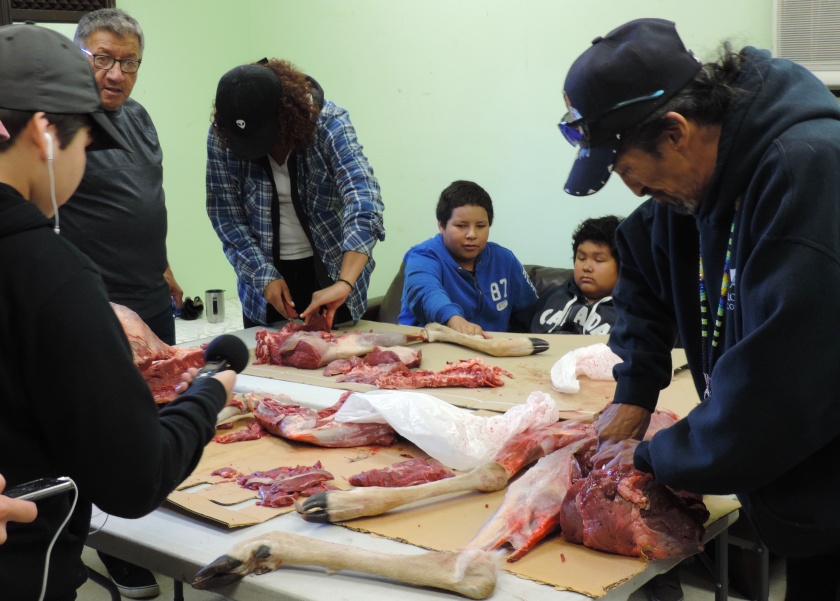
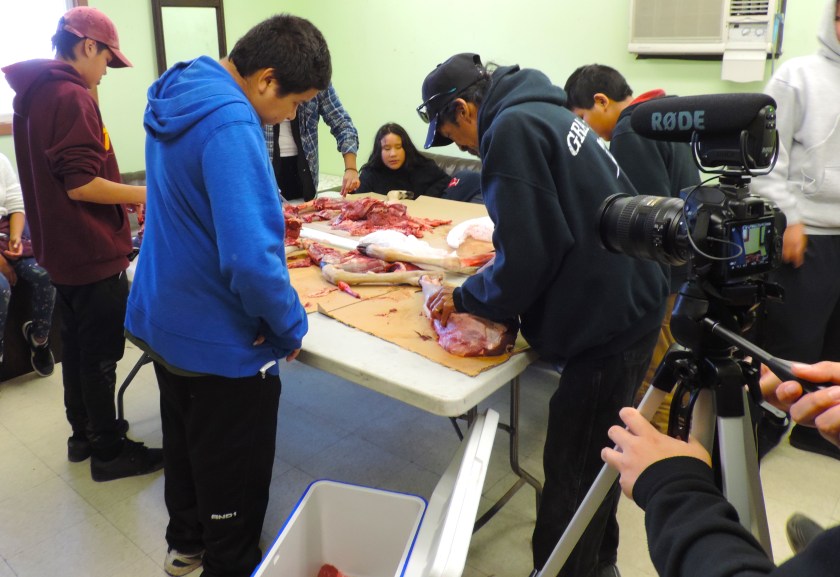
Students took turns sawing, slicing, cutting, and washing the meat. Alongside this, they were listening to cultural teachings and documenting with microphones, cameras and video cameras with the Naotkamegwanning’s community journalism trainer Karli Zschogner.

Teddy Copenace, the elementary land-based coordinator, guided them through the process, explaining the sacredness of the deer.

Kelsi Blackhawk photo credit
Student West Ranville jumps in to document audio and video as others take turns slicing deer meat, listening to teachings of Teddy Copenace (Photo Credit: Kelsi Blackhawk)

“The main protocols that I did was that we put tobacco down before we started cutting this deer up,” he said speaking to interviewer West Ranville. “This is someone’s clan and on top of that, the Creator is the one who gave us that deer for us to survive.”

He describes how the hooves are used for pow wow regalia, use the he use the hide as a drum, for moccasins, and a jacket to keep as warm

He also explains that out of respect for the animal, the skull and antlers are left with an offering of tobacco.

Teddy and West Photo Credit-Ocean Tom
Student West Ranville jumps in to document audio and video as others take turns slicing deer meat, listening to teachings of Teddy Copenace (Photo Credit: Kelsi Blackhawk)

Teacher Roland White says he was happy to students working with their hands.

“It’s part of our culture, it’s part of who who we are, to learn about animals,” he said.

Kelsi Blackhawk
Baibombeh students take turns cutting up deer meat and documenting (Photo Credit: Kelsi Blackhawk)

Lester Kavanaugh, the Senior Prevention Worker at Shawendaasowin Prevention Services hosted the space.  He says he got the deer after requesting community hunters to donate wild game.

“I am planning on doing is feeding the students at least once or twice a month hot lunch,” he said.

When interviewed, Sharia Yomi of Grade 12 said she would definitely do this again.

“It was a good experience,” she said. “So that our young know how to skin deer and know the teachings of our animals and spirits.”

Design a site like this with WordPress.com
Get started